01
Repositories multiply faster than judgement
AI writes more of your code every quarter, and each experiment leaves a repo behind. The estate grows; the number of people who know what is in it does not.
As AI writes more of your code, your repositories multiply and no one can say which are shippable, which are abandoned, and which are a liability. BNLGit is Gitea plus one thing — a typed, line-anchored summary of every file, stored as a real git mirror beside your source — so both your people and your agents work from evidence instead of guesswork.
Every organisation shipping AI-written code hits the same wall: more repositories, less shared understanding of what is actually in them.
AI writes more of your code every quarter, and each experiment leaves a repo behind. The estate grows; the number of people who know what is in it does not.
Finished, nearly finished, abandoned, or a liability — for most estates that answer lives in one or two people's heads, and leaves when they do.
A coding agent pointed at raw source infers what it can from whatever fits in the context window. Confident wrong answers are the expensive failure mode.
A summary written six months ago still reads as current. Nothing marks the moment it stopped being true, so stale context is indistinguishable from fresh.
Pair a repository and BNLGit creates a second, real git repository beside it, holding a summary twin for each of your source files — a readable summary plus a block of typed facts, each anchored to exact lines at a specific commit.
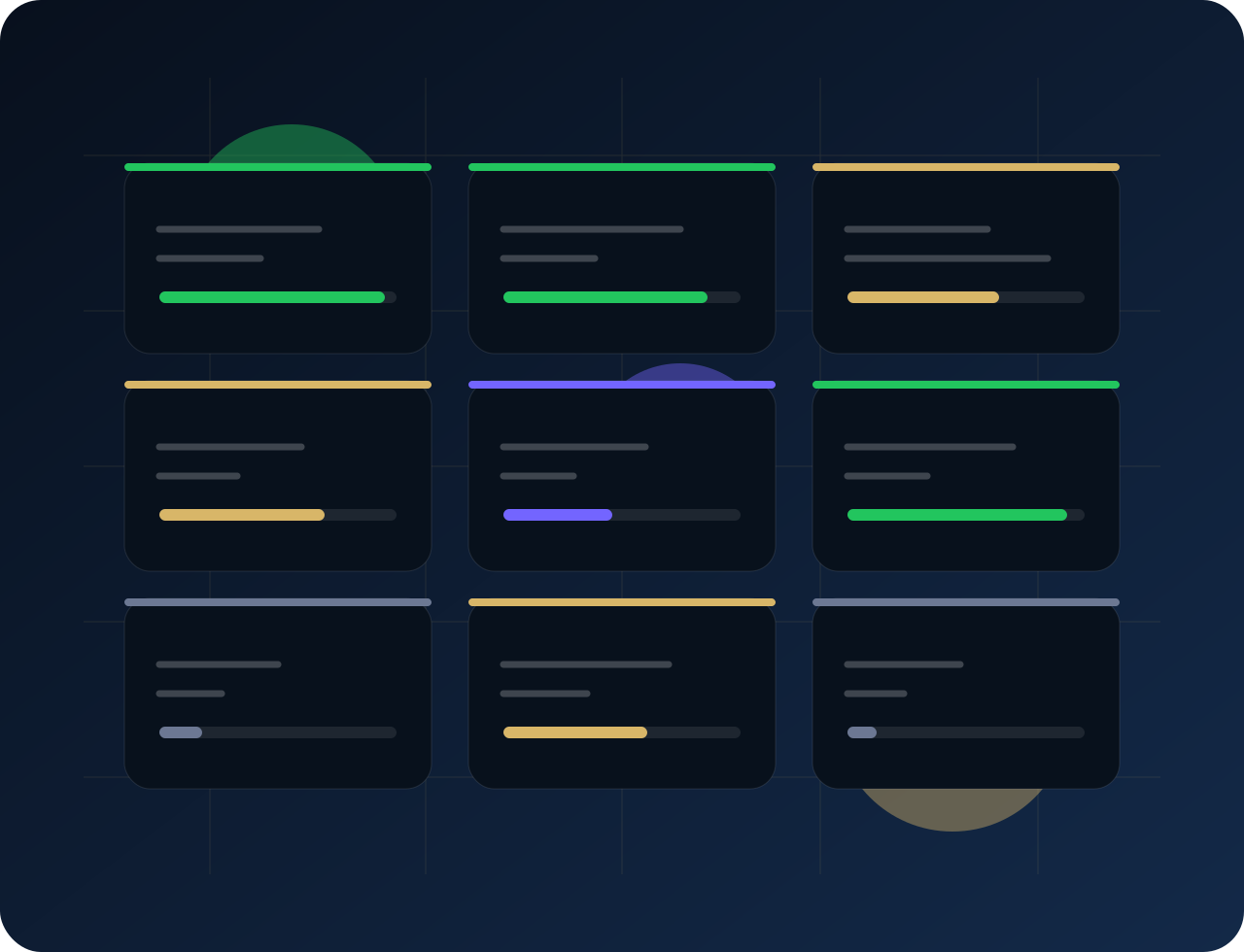
Every paired repository carries a state you can read at a glance across the whole estate — not a dashboard you have to interpret, a verdict you can act on.
When source moves on, the summary is marked stale and pushed down the ranking. It is never silently presented as current — which is the whole point.
Every fact points at a line span in a specific file at a specific commit, re-checked against the real file before it is returned. A human can verify the machine in one click.
Current prices, trial length and credit allowances live on bnlgit.com, which is the single source of truth for them. The shape of the model is what matters here.
Never per seat. Adding a reviewer, a contractor, or a whole team does not change the bill — so nobody is ever priced out of looking at the code.
You connect your own provider account. Your tokens are billed by your provider at your rate, and BNLGit does not mark them up.
Your source is not used to train models. What you push stays yours — the argument for BNLGit is mechanical, not a data grab.
Issues, pull requests, Actions, packages, webhooks and the API all behave exactly as upstream Gitea does. Standard git remotes, standard clone, no proprietary client.
Per-run and per-organisation cost ceilings cap what the summary worker can spend against your provider account before it stops and asks.
The full docs are public and need no account. You can judge whether it is worth your money before you enter a card.
Edition resolution fails closed: an instance configured with a value it does not recognise resolves to Lite, never Pro. Any client can ask a running instance what it actually has switched on — no signup required.
Core Git hosting and the mirror model.
Everything in Lite, plus the automated and agent-facing layer. The hosted service runs Pro.
BNLGit hosted beta
Open now, running the Pro feature set, with a free trial. Signups open when the public beta opens.
BNLGit Lite source release · AGPL-3.0-or-later
The Lite edition’s source, published under AGPL-3.0-or-later, to be released alongside BNLGit GA. Upstream Gitea and Gogs remain MIT with notices preserved verbatim.
Self-hosted Pro
A downloadable, single-customer deployment rather than shared multi-tenant hosting. Not part of the public beta.
The documentation is public and needs no account — read it first and decide for yourself. Or talk to us about the estate you are trying to get a grip on.
BNLGit is an independent product, not affiliated with or endorsed by Gitea Ltd. Built on the open-source Gitea project; upstream MIT notices are preserved verbatim.